OVERVIEW
Science
Parkinson’s disease (PD) is a chronic neurodegenerative disease. The prevalence of PD has doubled in the past 25 years. Global estimates in 2019 showed over 8.5 million individuals with PD. Current estimates suggest that, in 2019, PD resulted in 5.8 million disability adjusted life years (DALYs), an increase of 81% since 2000, and caused 329 000 deaths, an increase of over 100% since 2000. Globally, disability and death due to PD is rapidly increasing (WHO; https://www.who.int/news-room/fact-sheets/detail/parkinson-disease).
Clinically, the disease is characterized by motor symptoms including slowness of movements (bradykinesia), resting tremor, rigidity, and postural instability. These characteristic motor symptoms of PD result from the progressive loss of neurons containing the signaling substance dopamine in the brain. Although we often think of Parkinson’s disease as a movement disorder, patients with PD also suffer from multiple non-motor symptoms such as constipation, sleep disorders, hypotension, and loss of smell that can occur years before the onset of motor symptoms.
There is no cure for Parkinson’s disease, but therapies including medicines, surgery and rehabilitation can reduce motor symptoms. A major challenge remains to develop treatments that protect and restore dopamine neurons in patients with PD and alleviate non-motor symptoms.
Our solution
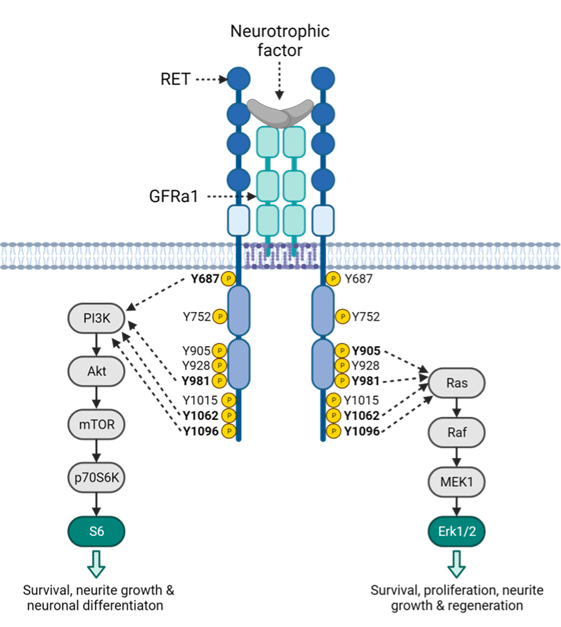
Glial cell-line derived neurotrophic factor (GDNF) is a protein belonging to the GDNF family ligands (GFLs) that have several biological functions such as cell survival, cell migration, cell differentiation, and neurite outgrowth. GDNF and related protein neurturin (NRTN), have been shown to promote the survival of cultured nigrostriatal dopamine neurons and protect and repair them in animal models of PD (Lin et al, 1993; Kirik et al, 2000; Kordower et al, 2006). Professor Mart Saarma and his collaborators discovered RET as the GDNF receptor in 1996 (Durbec et al 1996, Nature) and solved the crystal structure of GDNF-GFRα1 receptor complex (Parkash et al 2008, J. Biol. Chem.). By utilizing an integrated medicinal chemistry-biology approach, we have been able to develop small-molecule activators of GFRα1-RET that are able to protect and restore dopaminergic neuron networks.